41 Recruit to Interpreter Training Programs via Signing Community Housing
Issue: Limited opportunities for prospective interpreters to gain an immersion experience.
Proposed Solution: Coalition, particularly with state service agency representatives, develop, advocate and implement ASL housing – Community Housing for Deaf, DeafBlind and Hard of Hearing. There could be volunteers or stipend positions for ASL-as-a-second-language learners. These ASL learners can apply to interpreter training programs, be co-enrolled in ITPs or move into other careers where having ASL competency would benefit DDBHH individuals by reducing reliance on interpreters. There are different DDBHH/ASL living centers across the United States. PAH! in New Mexico is one example.
Expected outcome: More ASL skilled ITP students. DDBHH community housing option.
Who is impacted: Prospective interpreters, DDBHH persons wanting to live in community housing.
Timeline: 6 months
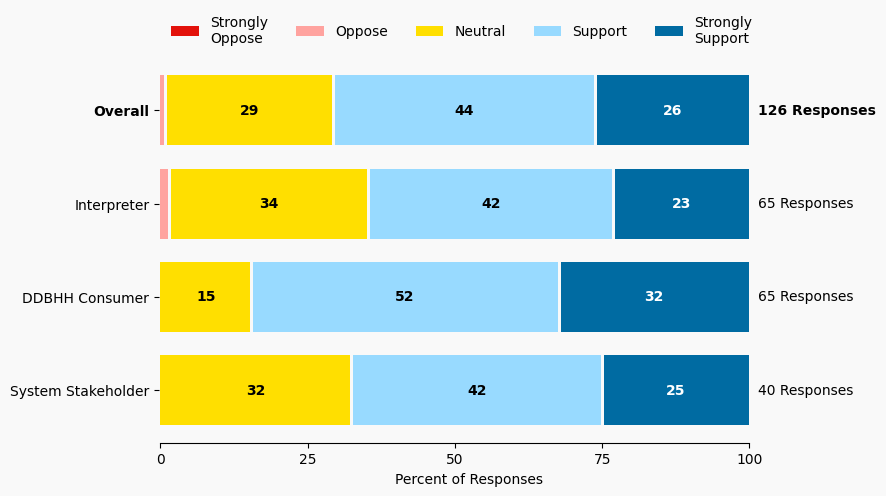
Summary of Support Image Description
The stacked bar charts show how respondents rated their level of support and the total number of responses. The percentage for the five support levels is shown from left to right: Strongly Oppose (Dark Red), Oppose (Light Red), Neutral (Yellow), Support (Light Blue), and Strongly Support (Dark Blue).
Respondents may identify with multiple subgroups. The overall level of support is:
Overall
Strongly Oppose: 0%
Oppose: 1%
Neutral: 28%
Support: 44%
Strongly Support: 26%
Click to see the detailed image description for each subgroup.
Interpreter
Strongly Oppose: 0%
Oppose: 2%
Neutral: 34%
Support: 42%
Strongly Support: 23%
DDBHH Consumer
Strongly Oppose: 0%
Oppose: 0%
Neutral: 15%
Support: 52%
Strongly Support: 32%
System Stakeholder
Strongly Oppose: 0%
Oppose: 0%
Neutral: 32%
Support: 42%
Strongly Support: 25%
Overview of Respondents Opting for In-Depth Solution Analysis
After indicating their support level, 13% of the 126 respondents opted in to further assess whether the solution would worsen or improve on five metrics. Of the opt-in reviewers (17 respondents), 58% supported the solution, 41% were neutral on the solution, and 0% opposed the solution.
The remaining 109 respondents did not opt in to further assess the solution. Of these people, 72% support the solution, 26% were neutral on the solution, and 0% opposed the solution.
Reviewer Evaluation of Solution Effectiveness
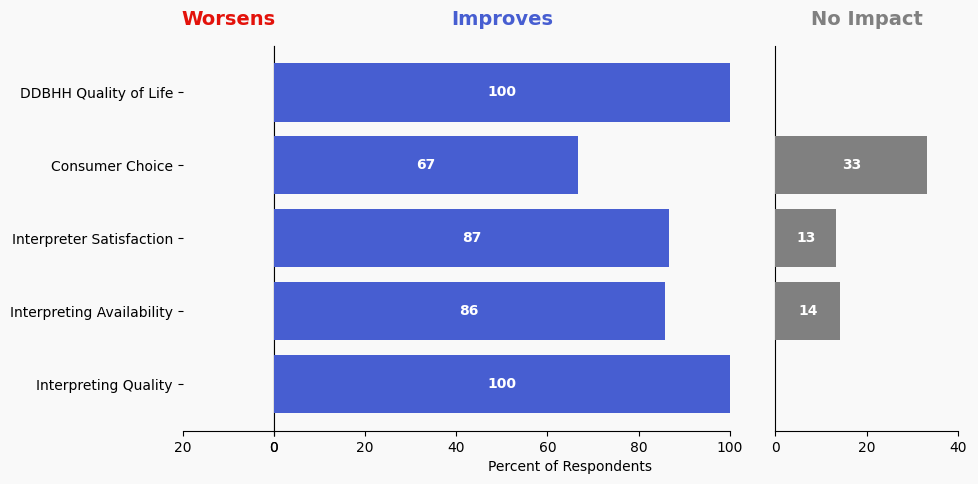
Solution Effectiveness Image Description
The stacked bar charts show how respondents assessed the effectiveness of this solution based on five metrics. For each metric, the percentage of respondents is shown from left to right: Worsens (Red), Improves (Blue), No Impact (Gray).
DDBHH Quality of Life
Makes It Worse 0%
Makes It Better 100%
No Impact 0%
Interpreter Satisfaction
Makes It Worse 0%
Makes It Better 86%
No Impact 13%
Consumer Choice
Makes It Worse 0%
Makes It Better 66%
No Impact 33%
Interpreting Availability
Makes It Worse 0%
Makes It Better 85%
No Impact 14%
Interpreting Quality
Makes It Worse 0%
Makes It Better 100%
No Impact 0%
Reviewer Feedback and Insights
Interpreter
The majority of the 126 respondents supported develop an ASL community housing for Deaf, DeafBlind and Hard of Hearing. Nearly a third of interpreters and System stakeholders remained neutral on this solution.
Deaf, DeafBlind, Hard of Hearing
Comments from DDBHH Consumers are broadly supportive. One comment suggests creating an exchange-like program for students interested in learning ASL. One comment raises concerns about the sustainability of this project and the need for significant effort to ensure it is set up properly.
System Stakeholder
Comments from System stakeholders note that signing community housing would be a significant asset to Deaf, DeafBlind, and Hard of Hearing students.
PREVIOUS SOLUTION
40 MRID Resolve to Host Annual Anti-Racism Workshops
Issue: Interpreters of color have regularly reported experiencing both explicit and subtle racist acts and microaggressions. As DDBHH consumers of color are woefully underserved by not having interpreters who reflect their identities, there is a need to support and encourage more interpreters of color in the field.
NEXT SOLUTION
42 Explore Interest in Community of Practice for CDIs in K12 Settings
Issue: Some DDBHH students require interpreting skills that can only be provided by CDIs. Currently, there are challenges with school districts hiring CDIs despite legislation in place to provide for CDIs in classrooms and the funding reimbursement to school districts for CDI services.
Leave a Reply